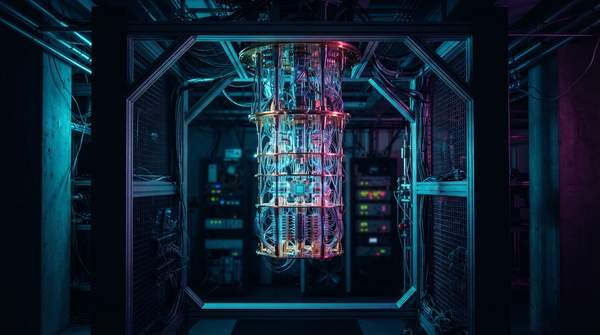
Standing over eight feet tall and wide, IBM's first two operational modular cryogenic systems were successfully joined and cooled to 4 Kelvin in under five days, marking a significant engineering feat for quantum computing in 2026. The successful joining and cooling of IBM's first two operational modular cryogenic systems created a unified environment capable of hosting advanced quantum processors. Quantum computers demand extremely stable, cold environments. Traditionally, scaling these systems meant building increasingly complex, monolithic cryostats, creating a major physical bottleneck. IBM's modular approach offers a more scalable and potentially faster path to commercial quantum advantage, shifting the bottleneck from physical infrastructure to qubit stability and error correction.
How IBM is Advancing Quantum Infrastructure
Each operational module stands over 8 feet tall and wide. The IBM newsroom reported these modules jointly cooled to 4 Kelvin in under five days, a feat confirmed by Data Center Dynamics. This rapid cooling and substantial size reveal the immense engineering required for viable quantum systems at scale. While many reports simply noted a 'connection,' the detailed scale and speed from IBM's newsroom highlight a more profound achievement. This capability suggests a future where quantum infrastructure deployment could mirror the efficiency of classical data centers, rather than custom-built labs.
Unlocking Scalability for Quantum Processors
IBM integrated two modular cryogenic systems to scale quantum computers across processors, as reported by Zacks Investment Research and EE Times. This modularity is crucial for future quantum computers, enabling qubit count expansion without demanding entirely new, monolithic cryostats. It decouples hardware development cycles, allowing IBM to scale quantum processors independently of cryostat designs. This could dramatically accelerate the iteration and deployment of increasingly complex quantum hardware, a critical step towards practical quantum advantage.