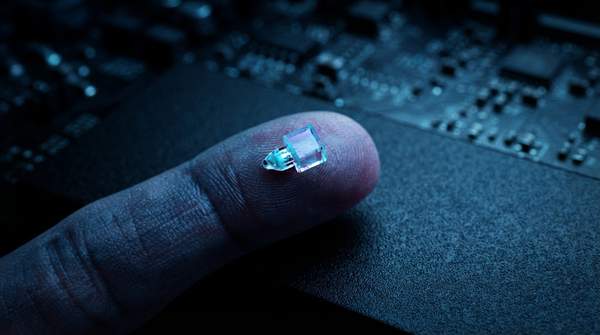
Quantum sensing's two most prominent magnetometer platforms—nitrogen-vacancy (NV) centers in diamond and optically pumped magnetometers (OPMs)—are not interchangeable substitutes but complementary tools with sharply different strengths. NV centers deliver atomic-scale spatial resolution and room-temperature operation from a solid-state crystal, while OPMs trade resolution for the raw magnetic sensitivity of macroscopic atomic ensembles. Understanding that split determines which platform fits a given job, from wearable brain imaging helmets to field-deployed anomaly detection.
Introduction to Quantum Sensing Platforms
Both platforms detect magnetic fields by exploiting quantum properties of matter, but they do so through fundamentally different media. An NV center is a defect lattice site in diamond whose transition frequency depends only on the magnetic field, fundamental physical constants and diamond-specific constants—meaning, as NIST's magnetometry program notes, the sensor needs no calibration and can be made straightforwardly traceable to the International System of Units. OPMs instead use clouds of optically prepared atoms whose spins respond to ambient fields.
A 2023 review in Nature Reviews Physics, authored by researchers including Nabeel Aslam, Ronald Walsworth, Mikhail Lukin and Hongkun Park, frames these two as "two promising quantum sensing platforms" and surveys biomedical case studies ranging from brain imaging to single-cell spectroscopy. The same review highlights a distinctive OPM capability: a wearable sensor helmet that lets a subject perform tasks and move while brain activity is recorded. Technical reporting on remote sensing adds that the quantum approach to magnetometry offers advantages over classical sensors in sensitivity, miniaturization potential, and operation under varied environmental conditions.
Performance Trade-offs: Sensitivity and Spatial Resolution
The central trade-off is ensemble size versus localization. NIST explains that NV-center magnetometers can be built with a single NV center for extreme spatial resolution, or with many NV centers for high magnetic sensitivity—a designer's dial between where a measurement is made and how weak a field it can detect. Harvard University researchers, spanning the Departments of Physics and Chemistry and Chemical Biology, made the same contrast explicit in work comparing the two platforms for molecular and materials analysis: macroscopic OPM ensembles offer magnetic sensitivity, while solid-state NV centers offer atomic-scale resolution.
For context, classical fluxgate magnetometers typically achieve sensitivities in the range of 1 to 10 picoteslas with spatial resolutions from millimetres to centimetres, according to NATO's Joint Air Power Competence Centre. NV centers and OPMs can both achieve nanoscale spatial resolution, the Centre reports. A peer-reviewed analysis of NV magnetometry for magnetoneurography and magnetomyography adds that the NV magnetometer's room-temperature operability and gradiometric configurations could make it highly sensitive in the picotesla-per-root-hertz range even without magnetic shielding.