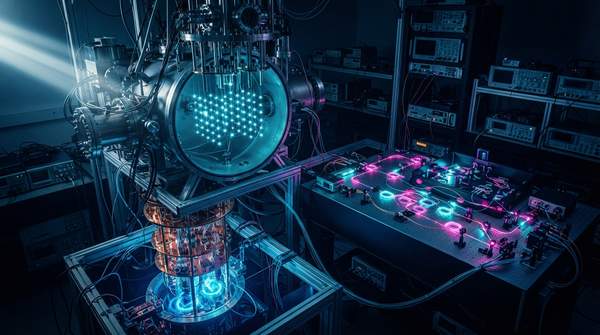
Neutral atom, photonic, and cat-qubit systems take three fundamentally different routes to the same destination: a fault-tolerant quantum computer. Neutral atoms encode information in individual atoms held in reconfigurable optical traps, giving them flexible connectivity that simplifies error-correcting codes. Photonic systems encode information in the continuous properties of light, promising room-temperature operation and large numbers of quantum modes. Cat qubits, a superconducting variant, suppress one entire class of error in hardware, sharply cutting the number of physical qubits needed per logical qubit. Understanding these distinctions is the key to evaluating which trade-offs matter most as each platform scales.
Introduction to Emerging Quantum Architectures
Superconducting circuits and trapped ions dominate today's quantum hardware landscape, but they are no longer the only serious contenders. As Mark Saffman of the University of Wisconsin-Madison notes in a recent review, neutral atom qubits have advanced at a rapid pace in recent years, moving from proposals formulated more than 25 years ago to demonstrations of quantum algorithms and logical qubits for fault-tolerant error correction. Meanwhile, newer modalities are maturing: continuous-variable photonics and superconducting cat qubits each attack the central problem of quantum computing—decoherence—in a different way. What unites all three emerging approaches is the recognition that hardware design and error correction codes must be co-designed, a fundamental principle in quantum computing where the physical encoding method directly shapes the error profile a system must manage.