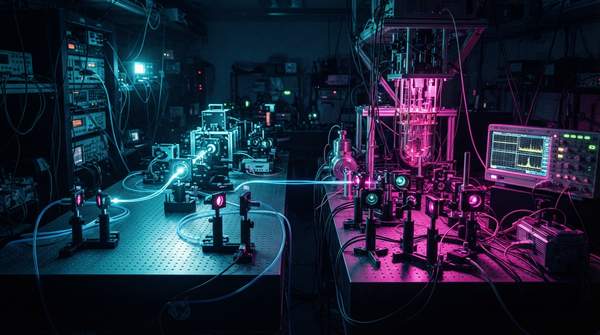
Quantum entanglement can be verified in two fundamentally different ways, and confusing them leads to real misunderstandings. Foundational Bell tests, pioneered in the early 1970s, were designed to settle a philosophical dispute about the nature of reality: whether Einstein's "local realism" or quantum mechanics correctly describes the world. Modern statistical methods, most prominently entanglement witnesses, serve a different purpose entirely — they efficiently certify that a quantum device actually contains entanglement, without fully characterizing its state. Understanding which method a claim rests on tells you whether you are hearing about fundamental physics or about the practical engineering challenge of building quantum computers, where verification efficiency has become a bottleneck in its own right.
The Enduring Mystery of Entanglement: Einstein's 'Spooky Action'
Entanglement is the quantum-mechanical phenomenon in which two or more particles share a single description, so that measuring one immediately constrains what can be found when the other is measured — no matter how far apart they are. As physicists at the University of Vienna describe it, if one entangled particle is influenced by an external measurement, the state of the other changes as well, regardless of the distance between them. Einstein found this implication deeply troubling, famously objecting to what he called "spooky action at a distance," and he argued that quantum mechanics must be an incomplete description of a deeper, classical reality.
The disagreement crystallized into a contest between two worldviews. Local realism holds that objects carry definite properties independent of observation and that no influence can travel faster than light. Quantum mechanics, by contrast, predicts that entangled particles exhibit correlations stronger than any local-realist account can allow. For decades this looked like a purely philosophical argument, untestable by experiment. That changed when theorists found a way to turn the dispute into a measurable statistical question — and when a young physicist named John Clauser decided to actually run the measurement, despite widespread skepticism from colleagues who considered the question unappealing or pointless.
Bell Tests: Proving the Nature of Reality
A Bell test works by measuring correlations between entangled particles along carefully chosen settings and comparing the observed statistical strength against a numerical ceiling that classical physics imposes. As QuEra Computing explains, classical physics establishes a rigid limit on how strong these correlations can be — known broadly as a Bell inequality, and in modern experiments specifically as the CHSH inequality. If the universe ran on local hidden variables, the correlation could never mathematically exceed a value of 2; entangled particles, however, routinely yield values approaching 2.828, directly violating the classical boundary.
John Clauser performed the first such test in 1972, and the outcome surprised even him. Recalling his experiment in a Caltech interview, he said: "I was very sad to see that my own experiment had proven Einstein wrong. But the experiment gave a 6.3-sigma result against him." A five-sigma result or higher is considered the gold standard for significance in physics, so the verdict was emphatic — and Clauser, who had bet against quantum mechanics, mailed a two-dollar bill to concede the wager. He went on to perform three more experimental tests at UC Berkeley, and all yielded the same conclusion: "Bohr was right, and Einstein was wrong."
Two features of Bell tests deserve emphasis. First, their goal is foundational: they address a debate about the nature of reality, not the performance of any device. Second, their validity depends on experimental design. As the Wikipedia overview of entanglement notes, many types of Bell tests have been performed with the goal of ameliorating problems of setup that could in principle affect earlier findings — a practice known as "closing loopholes in Bell tests." The focus is on statistical correlations from specific measurement settings, and decades of refinement were needed to make those correlations airtight. Clauser's work, shared with Alain Aspect and Anton Zeilinger, was recognized with the 2010 Wolf Prize in physics for "an increasingly sophisticated series of tests of Bell's inequalities."
Modern Verification: Certifying Quantum States for Technology
Today's quantum laboratories face a different problem. They are not asking whether quantum mechanics is right; they need to confirm that a specific, noisy, many-qubit device actually contains entanglement — quickly, and from limited data. The traditional gold standard for characterizing a quantum state is quantum state tomography, which reconstructs the complete description of a state from measurements. But completeness comes at a steep price: as researchers writing on arXiv point out, an N-qubit state is parameterized by 4^N − 1 real numbers, so full tomography requires effort that grows exponentially with system size. For a large quantum computer, that cost becomes prohibitive.
Entanglement witnesses offer a leaner alternative. A witness is a measurement-based test that confirms a state is entangled without revealing the whole state — a "yes/no" answer rather than a complete description. A review of entanglement detection methods surveys this landscape, covering Bell inequalities, entanglement witnesses, nonlinear properties measured on several copies, and spin-squeezing inequalities, with particular emphasis on the theory and application of witnesses. The field, as researchers led by Wiesław Laskowski and Harald Weinfurter write in npj Quantum Information, has evolved toward strategies directly applicable to experimental data, which is inevitably limited to a finite number of detection events; when that number is large, various forms of entanglement witnesses provide reliable verification, and even smaller data sets can now be analyzed using quantum state verification methods and tailored game-like protocols.
There is an interesting middle ground between the two extremes. Researchers publishing in IOPscience note that a tomographically complete measurement can ultimately identify a quantum state so that theoretical tools can completely determine whether it is entangled or separable — and from a practical point of view, it is highly desirable that entanglement-detection measurements be constructive, meaning they can be extended to a tomographically complete set by adding more detectors. In other words, a witness can be designed as the first, cheap stage of a fuller characterization, upgraded only if needed.
Comparing Entanglement Verification Methods
The clearest way to distinguish these approaches is to place them side by side. The table below categorizes the two main classes of entanglement verification by their underlying goals, what they actually prove, their data requirements, and their typical applications — with tomography included as the reference point that witnesses are measured against.
| Dimension | Bell Tests | Entanglement Witnesses |
|---|---|---|
| Primary goal | Experimentally test the validity of local realism against quantum mechanics — a foundational question about the nature of reality | Efficiently detect and certify the presence of entanglement in a quantum state — a practical confirmation for technological use |
| What it proves | Violation of Bell inequalities shows local realism is false, confirming entanglement as a genuine phenomenon; the proof concerns fundamental physics, not device performance | Confirms a state is entangled without fully characterizing it — a "yes/no" answer, not a complete state description |
| Data requirement | Specific correlation measurements against a classical ceiling (CHSH limit of 2 versus observed values near 2.828), with careful attention to closing experimental loopholes | Fewer measurements than full tomography, which scales exponentially (4^N − 1 parameters for N qubits); efficient even for limited data sets |
| Example application | Foundational physics experiments testing Einstein's objections, from Clauser's 1972 test onward | Certifying entangled states in large-scale quantum computers and characterizing inefficient quantum sources |
The comparison exposes a crucial asymmetry in what each method delivers. A Bell test makes a sweeping negative claim — local realism is false — but says nothing about whether your particular device is working. A witness makes a narrow positive claim — this state is entangled — but leaves the state otherwise uncharacterized. Neither is a substitute for the other, and a claim about entanglement verification should always be read with this distinction in mind: is it a fundamental test of reality, or a practical certification of a device's state?
The Critical Challenge of Efficient Verification for Quantum Technologies
The efficiency question is not academic. As the University of Vienna team notes, efficient verification methods have been tested for systems containing only a few qubits, but a physical quantum computer would involve much larger systems — and with conventional methods, verifying entanglement in large systems becomes challenging and time-consuming because many repeated experimental runs are required. The gap between what can be verified and what needs to be built is one of the field's practical bottlenecks.
Recent results show the gap can be narrowed. In 2019, a team from the University of Vienna and the Austrian Academy of Sciences, led by Philip Walther and Borivoje Dakić with colleagues from the University of Belgrade, demonstrated entanglement verification on a system of six entangled photons in which only a few experimental runs sufficed to confirm entanglement with confidence up to 99.99 percent. Their technique proved orders of magnitude more efficient than conventional methods, and in certain cases the number of measurements needed was independent of the system's size. Two years later, researchers in the UK, Spain and Germany reported a verification method designed to cut through noise — significant because quantum error correction, a crucial ingredient in bringing quantum computers into the mainstream, relies on sharing entanglement between many particles at once.
Small data sets carry their own risks, which is why statistical rigor matters as much as raw efficiency. The npj Quantum Information authors argue that it becomes crucial to properly apply the framework of statistical hypothesis testing to entanglement certification, in order to avoid significant misinterpretations of conclusions based on small sample sizes and to properly optimize the use of scarce experimental resources. Their work applies that statistical apparatus to witnesses evaluated on limited data — a reminder that a fast answer is only useful if it is a trustworthy one.
The Future of Quantum: Efficient Verification is Key
For the advancement of quantum technologies, prioritizing and developing efficient entanglement verification methods, such as advanced entanglement witnesses, is a critical engineering and research focus. The trajectory of the evidence points one direction: Bell tests settled the foundational question, and the frontier has moved to certifying ever-larger entangled systems with ever-fewer measurements, under realistic noise and finite data. A reader can track this progress concretely through the increasing number of research papers and experimental demonstrations showcasing entanglement verification methods that require fewer measurements or are robust to noise, particularly for multi-qubit systems — the measurable indicator of whether the field is actually solving its verification bottleneck. When the next claim of quantum advantage arrives, the right question to ask is not just how many qubits were entangled, but how efficiently that entanglement was proven.
Sources
- What Is a Bell Test? Quantum Entanglement and Local Realism — QUERA
- Proving that Quantum Entanglement is Real — California Institute of Technology
- Quantum entanglement - Wikipedia
- Entanglement Verification, with or without tomography — arXiv.org
- SITES
- Valid and efficient entanglement verification with finite copies of a quantum state - npj Quantum Information — Nature
- Linking entanglement detection and state tomography via quantum 2-designs - IOPscience
- Physicists develop new method to prove quantum entanglement — Phys.org