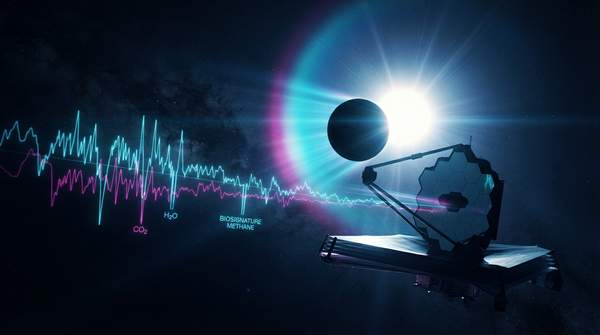
The James Webb Space Telescope searches for signs of life on distant worlds by reading starlight, not by photographing planets directly. When an exoplanet crosses the face of its star, a sliver of starlight filters through the planet's atmosphere on its way to the telescope. Molecules in that atmosphere absorb light at specific infrared wavelengths, leaving a chemical fingerprint in the spectrum. By comparing the star's light during transit with its light outside the transit, astronomers can infer which gases are present. It is a method powerful enough to detect carbon-bearing molecules in a habitable-zone planet, yet, as researchers stress, a detection alone is never proof of life.
How Transmission Spectroscopy Works, Step by Step
The technique depends on a geometric alignment: a transit, when the planet's orbit carries it between its star and the telescope. The planet itself blocks a fraction of the starlight, but the atmosphere blocks a little more—and crucially, it blocks it unevenly across wavelengths. Each molecular species absorbs at wavelengths characteristic of its structure, so the star's spectrum, recorded while the planet is transiting, carries darkened bands where atmospheric gases have intercepted photons.
The measurement is comparative by design. Astronomers record the star's spectrum before and after the transit, then again during it, and the difference between the two isolates the atmosphere's contribution. JWST's infrared instruments—NIRISS, NIRSpec, and MIRI—cover the near- and mid-infrared ranges where prominent molecules such as methane (CH₄), carbon dioxide (CO₂), water (H₂O), ammonia (NH₃), and organosulfur gases like dimethyl sulfide (DMS) all have strong spectral features, as the Cambridge-based Hycean research programme notes. The telescope's infrared sensitivity matters because these absorption bands sit at wavelengths where the instrument can resolve them against the star's glare.
The payoff is real. Using NIRISS and NIRSpec observations in the 1–5 micron range, that team reported the first detections of the carbon-bearing molecules CH₄ and CO₂ in a habitable-zone exoplanet, the candidate hycean world K2-18 b, in work led by Nikku Madhusudhan and colleagues in 2023. But the same geometry imposes limits. A review of remotely detectable signs of life cautions that transmission spectroscopy probes the atmosphere at a single orbital phase, excluding surface biosignatures and most proposed temporal biosignatures. It reads a slice of air, not the whole planet.
Comparative Guide to Potential Biosignature Gases
The table below compares the molecules most often discussed as potential biosignatures for JWST targets. The comparison runs across two axes at once: how biologically meaningful each gas would be, and how observationally and interpretively difficult it is to pin down. Read together, the columns show why a simple detection is never automatic proof of life—every promising gas carries both a biological rationale and documented non-biological escape routes.
| Molecule | Significance as a Biosignature | Detectability by JWST | Challenges & Ambiguities |
|---|---|---|---|
| Ammonia (NH₃) | Potential biosignature gas, especially in the atmospheres of gas dwarf planets | NIRISS, NIRSpec, and MIRI can detect NH₃ features from 1.5–6.1 μm via transmission spectroscopy | Feasible only under optimal conditions such as a clear atmosphere and low mean molecular weight; the 10.3–10.8 μm feature is very challenging in eclipse spectroscopy with MIRI given photon and systemic noise floors |
| Methane (CH₄) | Prominent molecule important for identifying hycean worlds and sub-Neptunes; part of broader habitability characterization | Strong spectral features across the JWST range; detected with CO₂ on K2-18 b using NIRISS and NIRSpec | Not, by itself, a biosignature in the cited evidence; also a feedstock for photochemical pathways that produce other organics |
| Carbon dioxide (CO₂) | Prominent molecule for identifying hycean worlds; part of broader atmospheric characterization for habitability | Strong spectral features across the JWST range; detected on K2-18 b | Not explicitly framed as a biosignature in the cited evidence; presence alone says little about biology |
| Dimethyl sulfide (DMS) | Promising biosignature candidate given its volatility, detectability, and potential biological origin; terrestrially produced primarily by biological processes | Strong spectral features across the JWST range; tentatively inferred on K2-18 b from NIRISS and NIRSpec data | Abiotic routes exist: photochemistry beginning with HS radicals from H₂S photolysis, and DMS has now been found in the interstellar medium; a ~3σ detection is not ironclad and requires multiple transits to confirm |
Two rows deserve emphasis. Ammonia's detectability, modeled by Caprice Phillips and collaborators in a 2021 study published by the American Astronomical Society, is conditional on atmospheric clarity and composition—their simulations varied cloud conditions, mean molecular weights, and NH₃ mixing ratios to rank targets, and their detection metric quantified how significant a given observation would be. DMS, meanwhile, carries the heaviest interpretive burden: it is the molecule most often headlined, and the one with the most documented non-biological escape routes.
The comparison also clarifies a distinction the public conversation often loses. Methane and carbon dioxide are prominently detectable and were the first molecules actually confirmed on K2-18 b, but the evidence frames them as atmospheric characterizers—markers of what kind of planet this is—rather than as biosignatures in their own right. The organosulfur gases, including DMS and its relative DMDS, are where the biosignature claim is strongest and the controversy loudest.
The Challenge of Confirmation: Why Biosignatures are 'Candidates'
The central difficulty is that a molecule's presence is not a molecule's origin. A 2025 review of prospects for detecting signs of life in the JWST era argues that JWST results force scientists to accept "parallel interpretations"—competing biological and non-biological explanations that may not be resolved until the next generation of observatories. Within the anticipated noise floor, JWST can reach perhaps a handful of habitable-zone planet atmospheres with the fidelity needed to designate a planet as a biosignature gas candidate, and even that requires refined inverse methods and physical models to quantify gas abundances and constrain the atmospheric context.
DMS illustrates the problem concretely. On Earth it is produced primarily by marine microbial metabolism, which is why it is considered promising. But photochemical studies published through IOP Science show organosulfur gases can form abiotically, with proposed pathways beginning with the HS radical produced from H₂S photolysis. More striking still, astronomers reported in 2025 the discovery of DMS in the interstellar medium—gas clouds with no biology at all—underscoring, as those authors write, the need for caution when using DMS as a reliable biomarker.
Context compounds the challenge. The K2-18 b claim of sulfur-bearing biosignatures rests on a roughly 3σ detection that its own discussants describe as not ironclad, requiring multiple transit observations to improve signal-to-noise. And finding DMS or DMDS on a non-ocean world would directly challenge the biosignature interpretation. For cooler terrestrial planets around magnetically active M-dwarf stars, evolving spots and faculae can mimic planetary spectral features, and tidally locked planets can have night sides cold enough to freeze atmospheric gases—both of which complicate the reading of transmission spectra.
That is why the researchers themselves frame their work as a beginning. "Our work is the starting point for all the investigations that are now needed to confirm and understand the implications of these exciting findings," said co-author Savvas Constantinou of Cambridge's Institute of Astronomy. Madhusudhan is blunter about the discipline required: "It's important that we're deeply sceptical of our own results, because it's only by testing and testing again that we will be able to reach the point where we're confident in them."
Navigating the Search for Life: A Cautious Path Forward
Scientists must continue to apply rigorous "parallel interpretations" to all potential biosignature detections, systematically ruling out non-biological origins before inferring the presence of life. JWST's role in this era is to designate candidates, not to declare discoveries—and the same review that coined the "parallel interpretations" framing notes that future telescopes and innovative observational strategies will be essential for reliable biosignature detection.
The measurable indicator of progress is concrete: future scientific publications will detail new atmospheric detections alongside comprehensive analyses of potential abiotic false positives and the specific planetary context. Readers watching this field should look for exactly that pairing—a gas name and, beside it, the full accounting of what else could have produced it, from photochemistry to stellar contamination. When a detection arrives without that accounting, skepticism is not cynicism; it is the method working as intended.
Sources
- Exploration of Exoplanet Atmospheres with the James Webb Space Telescope — ARXIV
- JWST - Hycean Worlds
- Strongest hints yet of biological activity outside the solar system — University of Cambridge
- Exoplanet Biosignatures: A Review of Remotely Detectable Signs of Life - PMC
- Detecting Biosignatures in the Atmospheres of Gas Dwarf Planets with the James Webb Space Telescope — CaltechAUTHORS
- Prospects for Detecting Signs of Life on Exoplanets in the JWST Era — arXiv.org
- Abiotic Production of Dimethyl Sulfide, Carbonyl Sulfide, and Other Organosulfur Gases via… — Iopscience
- On the abiotic origin of dimethyl sulfide: discovery of DMS in the Interstellar Medium — ARXIV