Lab-grown organs promise to relieve donor scarcity, but two intertwined problems stand between the laboratory and the transplant ward: engineering hurdles—above all vascularization and immune-compatible cell sourcing—and ethical questions that each technical choice creates, from donor consent to the moral status of brain organoids. Neither can be solved in isolation, because the decision to use one cell source over another is simultaneously a biological and a moral decision.
The Promise and Complexity of Lab-Grown Organs
Transplantation today is constrained by a shortage of donor organs and by the consequences of putting a foreign organ into a patient's body. As one systematic review of lab-grown organ research summarizes, donor scarcity, immune rejection, and the need for lifelong immunosuppression hinder recovery and extend rehabilitation periods. Regenerative medicine—combining stem-cell biology, biomaterials science, and 3D bioprinting—offers an alternative paradigm in which tissues are built rather than waited for.
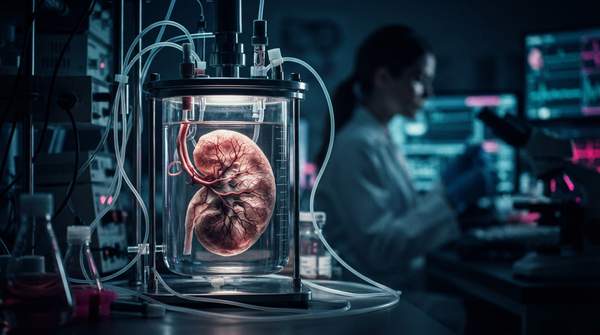
The field is not purely theoretical. The same review reports that lab-grown kidneys, livers, lungs, and cardiac tissues have demonstrated vascularization and partial physiological function in preclinical models. That word "partial" carries the weight of the whole field: researchers can already generate patient-specific tissues and miniature organs, known as organoids, that mimic the structure and function of native organs, but a fully functional, human-scale organ remains beyond current demonstrations.
Researchers around the world are developing these bio-artificial organs in preclinical settings specifically for transplantation into human recipients, using tissue engineering, 3D bioprinting, and organoid technologies. The gap between that ambition and current capability is where both the engineering and the ethics get difficult.
Engineering Hurdles: Building Functional Organs
The first barrier is vascularization—creating the dense, branching blood vessel networks that every real organ needs to survive. Cells deep inside a tissue die without a blood supply, so a printed or grown organ must be perfused from the moment it exists. Preclinical demonstrations of vascularized kidney, liver, lung, and cardiac tissues show the problem is being attacked, but achieving it reliably at full organ scale is another matter.
The second barrier is structural complexity. Bio-artificial organs are complex in a specific technical sense: unlike cell and gene therapies, they are organized in three-dimensional space, with many cell types that must be arranged correctly relative to one another. Replicating the intricate biological architecture of a native organ is inherent to the challenge—there is no shortcut that skips it.
The third barrier is achieving physiological function, meaning the construct must not merely look like a kidney or liver but perform its chemical and mechanical work in a living recipient. Demonstrations so far show partial function in preclinical models, not the sustained, full function a transplant patient would need. These three hurdles compound one another: vascularization is needed at scale, scale demands structural fidelity, and function depends on both.
Comparing Cell Sources for Lab-Grown Organs
Before an organ can be built, someone must decide where its cells come from. That choice is the clearest example of how engineering and ethics intertwine: each source solves one problem while creating another. The framework below compares the four main options along two axes—their engineering trade-offs and the ethical debates they trigger.
| Cell Source | Engineering Advantage / Limitation | Primary Ethical Concern |
|---|---|---|
| Autologous (patient's own cells) | Harvested, expanded, and modified in the lab for the individual patient; compatibility avoids immune rejection and immunosuppression, but manufacturing is complex and individualized. | Generally less problematic—avoids donor exploitation and animal-welfare issues—but informed consent remains crucial, especially if genetic modification is involved. |
| Allogeneic (human donor cells) | More scalable and cost-effective than autologous, but carries a higher risk of immune complications such as graft-versus-host disease and requires careful matching. | Donor consent, equitable allocation, and potential donor exploitation—issues known from organ transplantation generally. |
| Xenogeneic (animal-derived cells) | A potential supply answer, but immune rejection in human recipients is a major hurdle for successful transplantation. | Risk of xenozoonosis (disease transmission), animal welfare, and the moral status of human-animal chimeras—concerns unique to animal-derived materials. |
| Induced pluripotent stem cells (iPSCs) | Derived from a patient's own somatic cells and differentiated into various cell types; patient-specific like autologous cells, avoiding immune rejection, with scalability. | Deriving stem cells and creating human-like organoids raises moral questions about biological identity and organ ownership, especially for higher-order constructs like brain organoids. |
The pattern the table reveals is a trade-off, not a ranking. Autologous cells and iPSCs minimize immune rejection but demand complex, individualized manufacturing; allogeneic cells scale better but reintroduce matching problems and the familiar ethics of human donation. Xenogeneic sources could ease supply constraints but import a distinct set of animal-welfare and disease-transmission questions. No source escapes ethics—it only exchanges one debate for another.
Complexity compounds at the sourcing stage, too. A bio-artificial pancreas, for example, may require biological materials derived from deceased donors and new mothers, raising informed-consent issues familiar from organ transplantation and underscoring the importance of maintaining—and deserving—public trust.
Beyond Sourcing: Emerging Ethical Frontiers
As constructs become more sophisticated, new questions emerge that consent forms were never designed to answer. The most striking concerns brain organoids. According to a review of ethical challenges in organoid use, the ability of brain organoids to host consciousness or feel pain depends on their degree of development and maturity. Some researchers argue such concerns seem premature, since current organoids cannot yet interact and respond to stimuli or gain experience—but future methodological advances may allow brain organoids to develop cognitive functions comparable to the human brain. Human cortical organoids, a brain region that controls cognition and interprets sensory information, have already been developed by Muotri and colleagues.
The second frontier is the first-in-human trial itself. Early-phase trials of bio-artificial organs expose volunteers to serious risks, both predictable and unpredictable. To justify that exposure, the research and resulting intervention must have clear scientific and societal value—a demanding standard for a technology whose function is so far only partial in preclinical models. The moral status question and the trial-risk question converge: the more lifelike the construct, the harder both become to answer.
Navigating the Future of Lab-Grown Organs
The development of lab-grown organs requires a balanced and continuous engagement with both engineering innovation and evolving ethical considerations. The technical agenda—full vascularization, structural fidelity, physiological function—and the ethical agenda—consent, animal use, the moral status of complex organoids, and the justification for first-in-human trials—advance together, because every engineering choice selects a set of ethical obligations along with it.
For readers tracking the field, the measurable indicator is ongoing scientific reviews and the development of ethical guidelines by regulatory bodies and research ethics committees addressing the moral status of organoids and the risks of first-in-human trials. When those guidelines begin to treat complex organoids as more than mere tissue, or when a bio-artificial organ moves from preclinical vascularization into a justified first-in-human trial, both halves of this field will have crossed a threshold worth watching.
Sources
- Lab-Grown Organs- The Future of Rehabilitation: A Systematic Review — Healthcare Bulletin
- Autologous Cell Therapy: Types, Benefits & Challenges — Danaher Life Sciences
- Ethical Challenges in Organoid Use - PMC
- Frontiers Publishing Partnerships
- Ethics of Early Clinical Trials of Bio-Artificial Organs - PMC