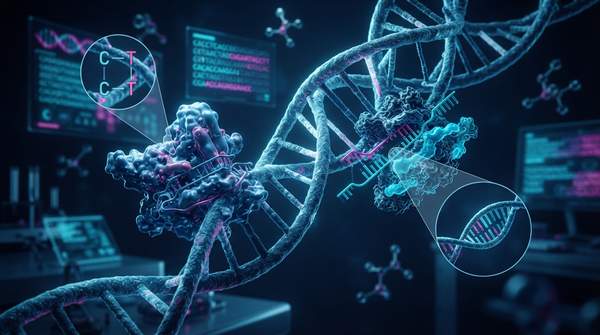
The original CRISPR-Cas9 system works like molecular scissors: it cuts both strands of DNA at a chosen site, then lets the cell's own repair machinery patch the gap. That blunt approach works, but the repair is unpredictable. Two later technologies—base editing and prime editing—take a different path. Both rewrite DNA letters directly, without creating the double-strand breaks that make traditional CRISPR risky. Base editing, built from a crippled Cas9 fused to a chemistry-changing enzyme, can swap certain single bases. Prime editing, described by David Liu's lab in a 2019 Nature paper as a "search-and-replace" technique, goes much further: it can perform all twelve possible base-to-base conversions, plus small insertions and deletions, with no double-strand breaks and no donor DNA template.
Introduction to Advanced Gene Editing
Most disease-causing genetic variants are small: a single swapped base, a missing letter, an extra one. Yet classic CRISPR-Cas9 was never really designed for fine corrections. It relies on the cell's response to a double-strand break, which can introduce unwanted insertions, deletions, or chromosomal rearrangements—outcomes that reviewers of the field flag as serious safety concerns for any therapeutic use. Base editing and prime editing both grew out of the same Cas9 targeting machinery, but they repurposed it. Instead of cutting DNA apart, they chemically rewrite it in place. The result is a gene-editing toolkit in which the question is no longer "can we reach this gene?" but "what exact change do we want to install there?"
Base Editing: Precision Single-Base Changes
A base editor is a fusion protein: a catalytically disabled nuclease—Cas9 that can no longer cleanly cut both strands—joined to a nucleobase deaminase enzyme, and in some designs a DNA glycosylase inhibitor as well. The disabled Cas9 does the targeting, guided by an RNA that matches the chosen genomic address. Once in position, the deaminase does the actual editing.
The chemistry is disarmingly simple. A deaminase removes an amino group from a nucleotide, a process called deamination. Cytidine deaminases convert a cytosine base into a uracil-like intermediate; the cell's own replication machinery then reads that intermediate as thymine. The net effect is a C•G-to-T•A conversion. Adenine base editors perform the mirror-image trick, converting A•T pairs into G•C. Together, as Lyndsey Fletcher notes in Front Line Genomics, these two editor classes cover the four "transition" mutations—C→T, T→C, A→G, and G→A—which account for a substantial share of known pathogenic point variants.
That is also the technology's ceiling. Base editing cannot swap a purine for a pyrimidine or vice versa—the "transversion" mutations—and it cannot insert or delete bases. As Fletcher puts it, base editing's biggest limitation is that very few types of point mutation can be changed using CBEs or ABEs. What it does, though, it does cleanly: point mutations can be installed without double-strand breaks or donor DNA templates, including in non-dividing cells, with few undesired editing byproducts.